
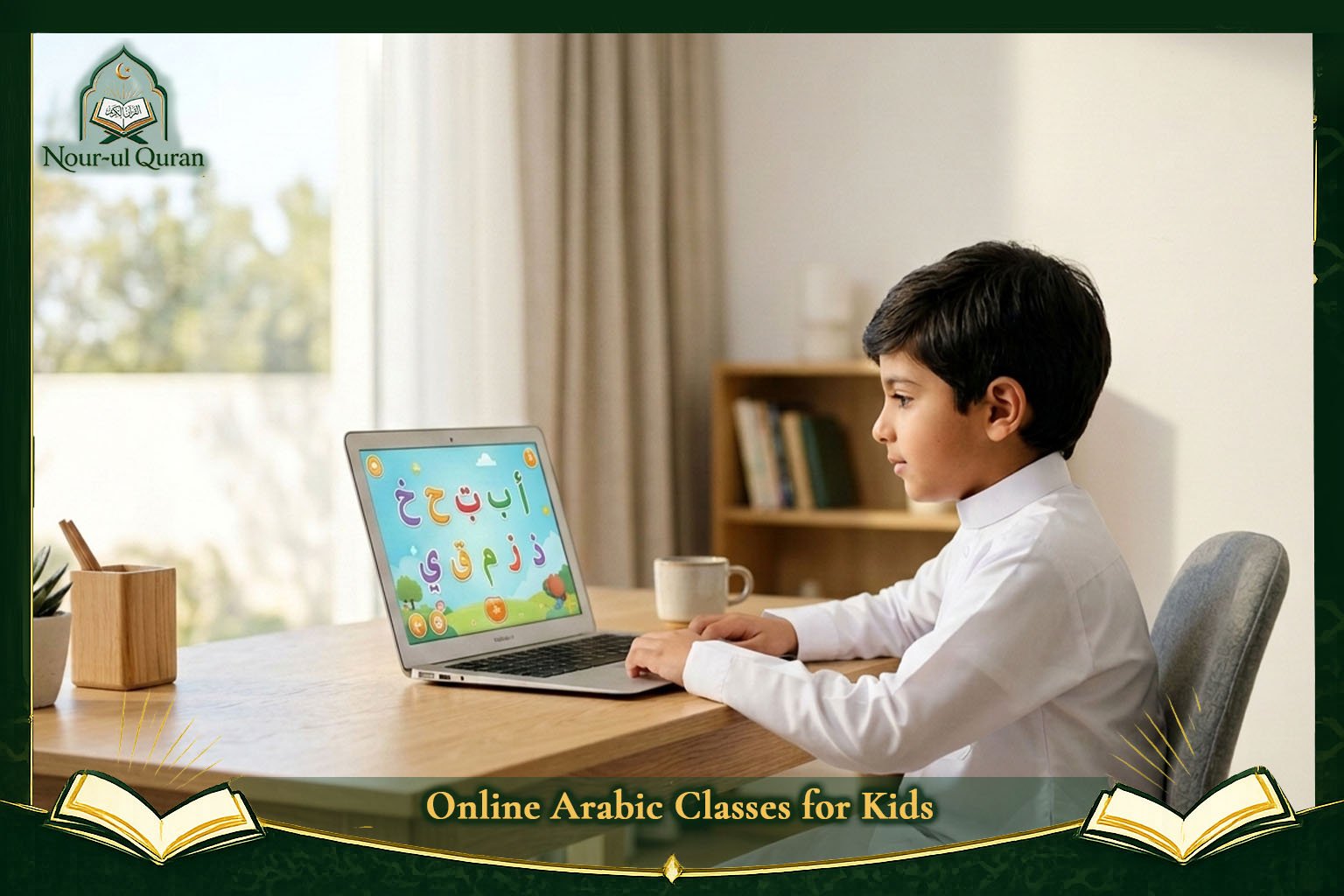
Online Arabic Classes for Kids: A Complete Parent's Guide
If you've been searching for online Arabic classes for your child, you've probably noticed something. There are hundreds of academies out there, all promising the same things: native tutors, flexible schedules, "proven" methods. It can get overwhelming pretty fast, especially when you're trying to figure out what's actually going to work for your own kid, not just what sounds good on a landing page.
I get it. Choosing how your child learns Arabic, especially if you're raising them outside an Arabic-speaking country, is one of those decisions that feels bigger than it looks on the surface. Arabic isn't just another subject to check off a list. For Muslim families, it's the language that unlocks the Quran directly, without a translation standing in between. For non Muslim families too, it's a language tied to history, culture, and a huge part of the world that a lot of school curriculums simply skip over.
So in this guide, we're going to walk through everything you actually need to know before signing up for online Arabic classes. Not the marketing version. The practical one. What to look for, what to avoid, how these classes actually work day to day, and how to tell if a program is genuinely helping your child or just keeping them busy for thirty minutes a week.
Why Arabic Still Matters, Even Today?
It's easy to assume that with translation apps everywhere and instant subtitles on every video, learning a "hard" language like Arabic isn't as necessary as it used to be. But that's not really how language and identity work.
For Muslim children specifically, Arabic is the language the Quran was revealed in. Every translation, no matter how well done, is an interpretation. There's a reason scholars have spent centuries studying the nuances of Arabic grammar just to understand a single verse properly. When a child learns Arabic, even at a basic level, they start to notice things in the Quran that a translation simply cannot carry over. Word choices, rhythm, subtle emphasis. That connection is hard to replicate any other way.
There's also the everyday, non-religious side of it. Arabic is spoken by over 400 million people across more than twenty countries. If your child ever visits family abroad, travels through the Middle East or North Africa, or just wants to understand the news, songs, or conversations happening in Arabic online, having even a working knowledge of the language opens doors that would otherwise stay closed.
And honestly, there's a confidence piece too. Kids who grow up bilingual, or working toward it, tend to develop stronger memory skills and a sharper ear for language patterns in general. Teachers and parents both notice it. It's not magic; it's just how the brain works when it's regularly switching between two different systems of sounds and grammar.
Help Your Child Learn Arabic Online
Give your child the opportunity to develop useful Arabic language skills through Online Arabic Classes for Kids at Nour Ul Quran Academy. Our online lessons are designed to make Arabic learning simple, structured, and suitable for young learners.
With personalized instruction and engaging teaching methods, children can gradually improve their vocabulary, reading, pronunciation, and understanding of Arabic. Learning from home also gives families greater flexibility when creating a regular study schedule. Enroll your child in our Online Arabic Classes today and help them build a strong foundation in the Arabic language.

What Actually Makes Online Arabic Classes Good (Not Just Convenient)?
Convenience is nice, but it shouldn't be the only reason you pick a program. Plenty of academies are convenient and still leave kids stuck at the same level a year later. Here's what separates classes that actually move the needle from ones that just fill a time slot.
Live, One on One Instruction
Group classes have their place, but for younger learners especially, one on one sessions make a massive difference. A tutor working with a single child can adjust pace instantly. If your child is struggling with a specific letter sound, the tutor can slow down right there and then, instead of moving on because the rest of a group is ready to continue.
This matters even more with Arabic, because the letters and sounds are genuinely unfamiliar to a lot of children who grow up speaking English, French, or any non-Semitic language at home. Sounds like the "ع" or the "ق" don't exist in most Western languages, and kids need repeated, personal correction to get them right.
A Structured Curriculum, Not Random Lessons
Ask any program you're considering what their curriculum actually looks like. A serious academy should be able to explain, clearly, what a child learns in month one, month three, and month six. If the answer is vague, that's a sign the lessons might be improvised rather than building toward something.
Good online Arabic classes usually follow a progression something like this: alphabet recognition and pronunciation first, then basic reading (often through something like the Noorani Qaida for Quranic Arabic specifically), followed by vocabulary building, simple sentence construction, and eventually conversational practice and grammar rules.
Qualified, Vetted Teachers
This one seems obvious, but it gets overlooked constantly. Not every native Arabic speaker is a good teacher, and not every certified teacher is good with children specifically. You want tutors who have real experience working with kids, who understand how to keep a seven year old engaged for thirty minutes without losing them halfway through.
For Quran focused Arabic learning, look for academies that work with Al Azhar certified instructors. Al Azhar University in Cairo has been a center of Islamic and Arabic scholarship for over a thousand years, and tutors trained there tend to bring a level of depth that's hard to find elsewhere, especially when it comes to Tajweed rules and classical Arabic grammar.
Regular Progress Updates for Parents
You shouldn't have to guess how your child is doing. A good program sends you regular updates, weekly if possible, covering attendance, what was covered in each session, and where your child needs more practice. This keeps you involved without requiring you to sit in on every single class.
The Real Benefits of Online Arabic Classes Compared to In-Person Options
A lot of parents still feel a bit unsure about online learning, especially for something as meaningful as Quran and Arabic education. That hesitation is fair. But once you look at how it actually plays out, the online format often ends up being the more practical choice, not a lesser one.
Access to teachers you simply couldn't reach otherwise. If you live in a smaller city or a country with a limited Muslim community, finding a qualified, Al Azhar trained Arabic and Quran teacher nearby might not even be an option. Online classes remove that geography problem entirely. Your child can learn from a tutor in Cairo while sitting at your kitchen table in Toronto, London, or Sydney.
Scheduling that actually fits real family life. Between school, sports, homework, and everything else, finding a fixed weekly slot that works for a physical class can be a nightmare. Online academies that operate across time zones, seven days a week, give you room to actually fit lessons around your life instead of rearranging your life around lessons.
A calmer, more focused learning environment. Some kids genuinely learn better one on one, away from the social pressure of a classroom full of peers. They're less afraid to make mistakes, repeat a word wrong five times, or ask a "silly" question when it's just them and their tutor on the screen.
Lower overall cost. Without the overhead of a physical building, online academies can usually offer private one on one tutoring at a price point that would be hard to match with in person private lessons.
None of this means in person learning is bad. Mosque based Quran and Arabic classes have their own value, especially the community aspect. But for a lot of families, particularly those living in Western countries without easy access to that kind of setup, online Arabic classes fill a gap that would otherwise just stay empty.
How Online Arabic Classes Support Quran Learning Specifically?
This is where things get interesting for a lot of Muslim families. Arabic and Quran education aren't really separate tracks, they overlap constantly, and the best programs treat them that way.
When a child understands Arabic grammar, even at a basic level, memorization of the Quran becomes less like memorizing random sounds and more like memorizing meaningful sentences. That difference matters enormously for retention. Kids who understand roughly what a verse means tend to remember it longer than kids who are purely repeating sounds phonetically.
Tajweed, the set of rules governing correct Quranic pronunciation, also becomes much easier to grasp once a child has a foundation in Arabic letters and their proper articulation points. A tutor teaching Tajweed to a student with zero Arabic background has to do double the work, explaining both the rule and the underlying sound at the same time.
This is why a lot of academies, including ours at Nour-ul Quran Academy, structure their programs so Arabic language classes and Quran classes reinforce each other rather than running as two completely disconnected subjects. A child working on Quran memorization in one session and Arabic vocabulary in another starts to notice the same words showing up in both places, and that repetition builds real, lasting understanding rather than surface level familiarity.
Questions to Ask Before Choosing an Online Arabic Program
Before committing, it's worth having a short conversation with any academy you're considering. Here are the questions that tend to reveal the most.
Who exactly will be teaching my child, and what's their background? Ask specifically about qualifications, not just "years of experience." A tutor with an Al Azhar background or recognized Ijazah in Tajweed carries a different level of credibility than someone with informal experience only.
What happens if we're not happy with the tutor? Personality fit matters a lot, especially with kids. A program that allows you to request a tutor change without hassle shows they actually prioritize your child's comfort over just filling a schedule.
What's the makeup policy for missed classes? Life happens. Ask clearly what happens if your child misses a session, and what happens if the tutor cancels. A fair policy protects both sides.
Is there a trial class available? This is honestly one of the most useful things you can do before committing to a monthly plan. A short trial lets you and your child get a feel for the teaching style, the platform, and whether the pacing suits your child, all before any real financial commitment.
How is progress actually tracked and communicated? Vague answers like "we'll let you know if there are issues" aren't good enough. You want specifics: weekly reports, monthly assessments, whatever system they use.
What the First Few Weeks Actually Look Like?
If you've never enrolled a child in online classes before, it helps to know roughly what to expect so it doesn't feel like a total unknown.
In the first session or two, a good tutor will usually spend time simply getting to know your child rather than diving straight into heavy content. This includes a quick assessment of where they currently stand: do they recognize any Arabic letters already, have they had any prior exposure, are they naturally shy or more talkative on camera.
From there, lessons typically settle into a rhythm. Short warm up review of the previous session, new material introduced in small chunks, then guided practice where the tutor listens and corrects in real time. For younger children, good tutors also build in short breaks or lighter interactive moments, since attention spans at that age are genuinely limited, no matter how good the teacher is.
Parents often ask how much homework to expect. It varies, but generally a reasonable program will assign five to fifteen minutes of daily practice, not hours. Overloading a young child with homework on top of everything else in their day tends to backfire and kill motivation rather than build skill.
By around the four to six week mark, you should start noticing small but real signs of progress. Maybe your child starts recognizing letters on packaging or signage. Maybe they start humming or repeating a phrase from their lesson unprompted. These small moments are usually a better indicator of progress than any formal test.
Common Challenges Parents Run Into (and How to Handle Them)
No learning journey is perfectly smooth, and it helps to know the common bumps ahead of time so they don't throw you off when they show up.
The "my child won't focus" problem. This is probably the number one concern parents raise. A few things help here: keeping the learning space free of distractions (turn off the TV in the background, keep siblings out of the room during class), sitting nearby during the first few sessions until your child settles into the routine, and choosing a time of day when your child isn't already exhausted from school.
Slow perceived progress. Language learning, especially for something as different from English as Arabic, is not linear. There will be weeks where it feels like nothing is sinking in, followed by a sudden jump where several things click into place at once. This is completely normal and shouldn't be read as a sign the program isn't working.
Technical hiccups. Internet issues, camera problems, kids accidentally muting themselves for half the session. These happen. A good academy will have a responsive support team to sort out technical issues quickly rather than leaving you to troubleshoot alone.
Resistance from the child themselves. Especially with younger kids, some initial pushback is normal. This usually softens once they build a relationship with their tutor and start feeling a sense of accomplishment, even small wins like correctly reading their first full word.
Simple Ways to Keep Kids Motivated
A few small habits at home can make a noticeable difference in how much a child actually absorbs and enjoys their lessons.
Celebrate small milestones out loud. When your child reads their first sentence or correctly pronounces a tricky letter, make a bit of a deal out of it. Kids respond strongly to genuine, specific praise, more than generic "good job" comments.
Connect lessons to real life where you can. If your child learns the Arabic word for "book" or "water," point it out casually during the day. "Hey, do you remember the Arabic word for that?" This kind of light reinforcement, without turning it into a quiz, helps things stick.
Keep sessions consistent. Same days, same general time if possible. Kids, even more than adults, do better with predictable routines rather than classes that get rescheduled constantly.
Involve the whole family occasionally. If you have some Arabic knowledge yourself, even basic, practicing together for a few minutes shows your child that this is something valued at home, not just an assignment from a stranger on a screen.
Why Families Choose Nour-ul Quran Academy?
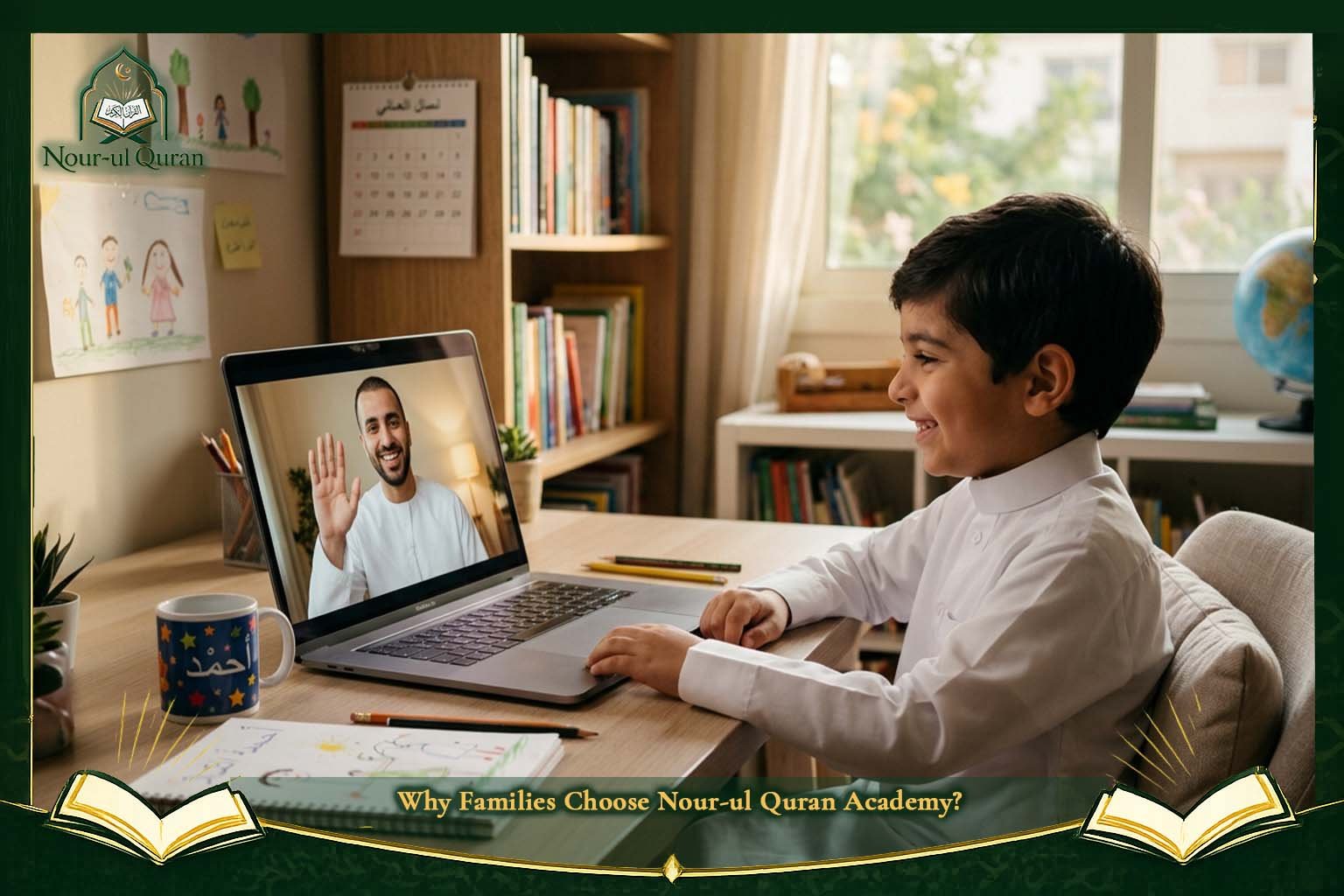
At Nour-ul Quran Academy, we built our program around exactly the concerns most parents raise before they even ask. Our tutors are Al Azhar certified, based in Egypt, and specifically trained to work with children living in the USA, UK, Canada, Europe, and Australia, which means they understand the challenges of learning Arabic away from an Arabic speaking environment.
Every class is live, one on one, conducted over Zoom, so your child gets full attention from their tutor in every single session. Our scheduling runs seven days a week across all time zones, so you're never forced to squeeze lessons into a slot that doesn't actually work for your family.
We also send weekly progress reports so you always know exactly where your child stands, what's been covered, and what needs a bit more focus. And if a tutor ever isn't the right personality fit for your child, our team handles the switch quickly, no awkward back and forth required.
Whether your child is starting from zero, learning their very first Arabic letter, or already progressing through Tajweed and Quran memorization, our courses are structured to grow with them, step by step, rather than throwing everything at them at once.
Frequently Asked Questions
At what age can my child start online Arabic classes? Most academies, including ours, welcome children starting from around age four, with lessons adjusted for attention span and comprehension level at that age.
How many classes per week are recommended? Two to three sessions a week tends to strike a good balance between steady progress and not overwhelming a young learner, though this can be adjusted based on your child's goals and schedule.
Do online Arabic classes work for complete beginners? Yes, absolutely. In fact, most children starting online Arabic classes are complete beginners, and a good curriculum is built to start from the very basics, including letter recognition and correct pronunciation.
Is a strong internet connection necessary? A stable connection helps a lot, since classes are conducted live over video. Most home internet connections are more than sufficient, but it's worth testing your setup before the first session to avoid interruptions.
Can adults join online Arabic classes too, or is it only for kids? While this guide focuses on children, most academies, ours included, also offer Arabic and Quran classes for adults who want to learn alongside their kids or start their own journey.
Final Thoughts
Choosing online Arabic classes for your child is a decision that pays off in ways that go far beyond just picking up a new language. It's a connection to the Quran, to a wider Muslim identity, and to a rich linguistic and cultural world that a lot of children growing up outside Arabic speaking countries otherwise miss out on entirely.
The key is being a little bit selective. Ask real questions, try a trial class before committing, and pay attention to how your child actually responds to their tutor, not just how polished an academy's website looks. Progress with language learning takes patience, but with the right structure and the right teacher, it happens more steadily than most parents expect.
If you'd like to see how this looks in practice, Nour-ul Quran Academy offers a trial session so you and your child can experience a live class firsthand before making any commitment. Sometimes the easiest way to know if something is right is simply to try it.