

New Zealand's Muslim community is small by global standards, somewhere around one to two percent of the population, and spread thinly even within that. Auckland has the largest concentration by far. Everywhere else, from Wellington to Christchurch to the countless smaller towns scattered across both islands, families are often working with genuinely limited local options, sometimes none at all beyond informal arrangements with whoever in the community happens to know Quran well enough to help out casually.
This isn't a criticism of those informal efforts, which come from real generosity and good intention. It's simply an honest acknowledgment that a country with New Zealand's population and geography can't always support the kind of dedicated, structured children's Quran education that exists more readily elsewhere. Online Quran classes New Zealand families have started turning to fill exactly this gap, and it's worth understanding both why it works and what to actually look for.
The Isolation Factor, and Why It Cuts Both Ways
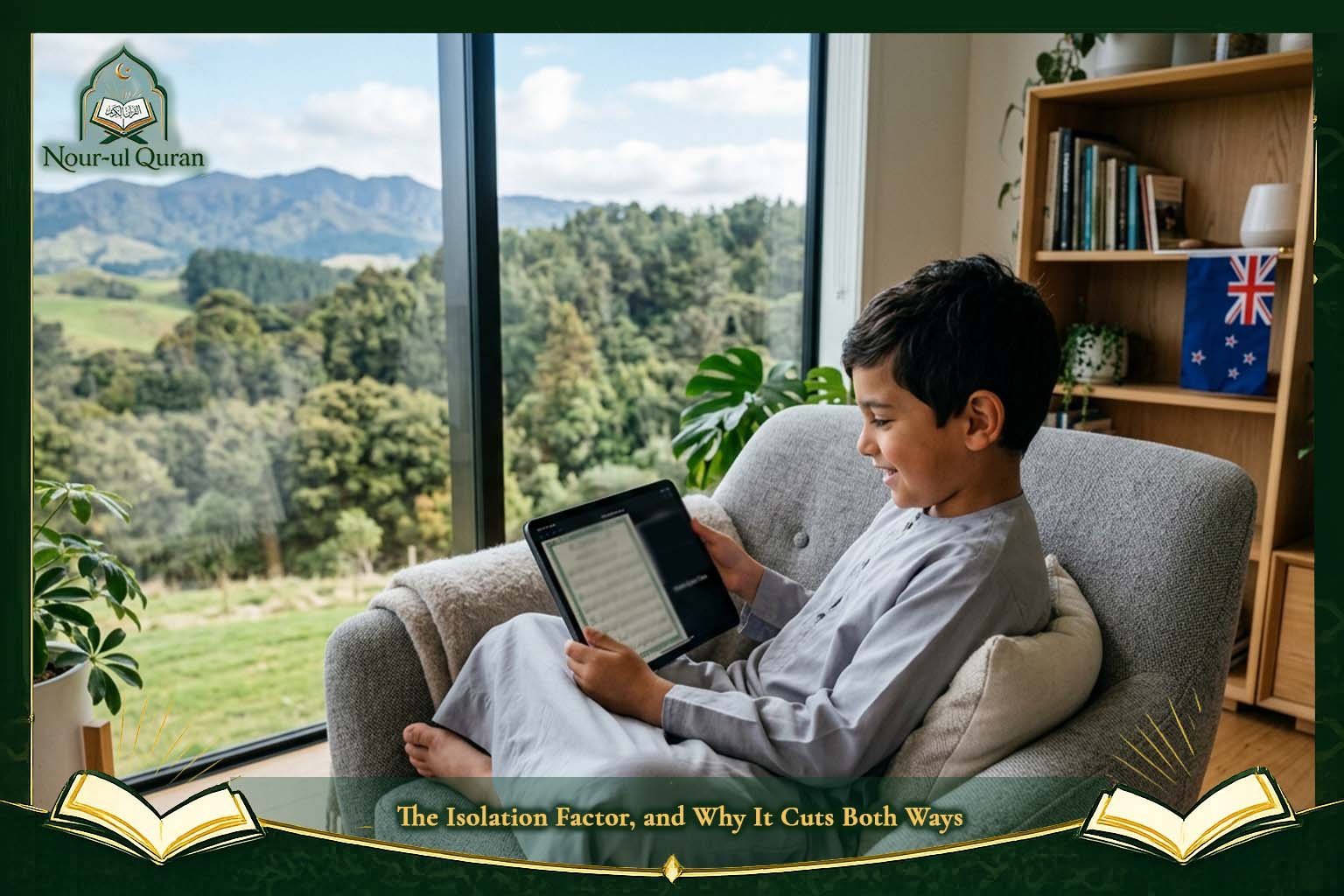
New Zealand's relative geographic isolation, something Kiwis are well used to navigating in plenty of areas of life, plays out in Quran education too. A family in a smaller town might be genuinely hours from the nearest mosque with any kind of children's program. Even families in Auckland sometimes find themselves on waitlists or squeezed into group classes larger than ideal, simply because demand outpaces the limited number of qualified local teachers.
Here's the flip side, though. Once you remove geography from the equation entirely, which online classes do, New Zealand's isolation stops mattering at all. A tutor in Cairo doesn't care whether your family lives in central Auckland or a rural corner of the South Island. The lesson happens exactly the same way either way.
An Underrated Advantage: New Zealand's Time Zone
Here's something a lot of families don't expect going in. New Zealand sits roughly nine to eleven hours ahead of Egypt depending on daylight saving. On paper, that sounds like a scheduling headache. In practice, it often works out unusually well.
Egypt's evening hours, when tutors are actively teaching, land during New Zealand's morning, often before school. For a lot of Kiwi families, this actually turns into a genuine advantage rather than an obstacle. A short Quran lesson before the school day starts, while a child's mind is fresh rather than already tired from a full day of classes and activities, tends to work better for both focus and retention than trying to squeeze something in during an already busy evening.
Not every family's morning routine has room for this, of course, and evening slots are usually available too depending on the specific academy. But it's genuinely worth asking about morning availability specifically if your family's evenings are already stretched thin with school pickup, sport, and dinner.
Quick Answers to What Kiwi Parents Usually Ask First
Can a tutor really correct pronunciation properly over video from this far away? Yes. Correction relies almost entirely on hearing clearly, and a stable video call handles this just as well as sitting in the same room, regardless of physical distance.
Will my child actually get individual attention, or is this just a bigger version of a group class online? In a properly run program, sessions are one on one, meaning the tutor's full attention is on your child the entire time, with no other students to divide focus between.
Is this only for younger kids, or does it work for older ones catching up too? Both. Programs typically adjust curriculum and pacing based on age and existing ability, whether that's a four year old starting from nothing or a ten year old correcting habits picked up informally over the years.
What if we're not sure Quran memorization is even our goal yet? That's completely fine, and common. A lot of families start with basic reading and correct Tajweed first, and decide on memorization goals later once they've got a sense of how things are progressing.
Building a Program Around Where Your Child Actually Is
Every child's starting point is different, so it's worth thinking about this in terms of what your specific child needs rather than a generic package.
Starting completely from scratch, no Arabic letters recognized at all: online Quran classes for beginners builds this from the ground up, patiently and without assuming any prior knowledge.
Already reading, but pronunciation habits never properly corrected: online Tajweed classes works specifically on identifying and fixing these, letter by letter if needed.
Working toward memorizing chapters or the full Quran: online Quran memorization classes follows the traditional structured review method used in Hifz programs everywhere, paced realistically for a child balancing New Zealand school life alongside it.
Limited exposure to Arabic as a language beyond Quran reading itself: online Arabic classes for kids builds vocabulary and comprehension that makes everything else considerably more meaningful.
Wanting a fuller picture of belief and practice, not just reading and reciting: Islamic Studies for kids covers this directly, and Islamic Studies for adults is there if you're looking to build your own knowledge alongside your child's.
Red Flags Worth Watching For

Rather than just listing what a good program includes, it's arguably more useful to flag what should make you pause.
Be cautious of any academy that can't clearly describe what your child will actually cover over the coming months, since vague answers here usually mean lessons are improvised rather than following real structure. Be wary of programs promising unusually fast results, like complete memorization in under a year for an average student, since this typically means either rushed fundamentals or an exaggerated claim. Watch out for a lack of clarity around teacher qualifications, since "experienced" alone tells you very little without specifics like Al Azhar training or formal Ijazah. And be careful of rigid scheduling systems that don't account for New Zealand's specific time zone or offer only one or two fixed slots, since this often signals a program that wasn't really built with international students in mind.
For a more complete rundown of what to actually check before committing, our guide on how to choose an online Quran academy covers this thoroughly, and our comparison of online Quran academy vs local mosque is worth a look if you're weighing this against whatever limited local option you might already have access to.
Making It Actually Work Long Term
Consistency matters more than intensity here, and this holds especially true for busy New Zealand households juggling school, work, and everything else. Our piece on online Quran learning for busy families covers practical ways to keep a routine sustainable rather than something that quietly falls apart after a term.
If you're still weighing whether structured classes are genuinely worth it compared to continuing informally, our overview of the benefits of joining an online Quran academy and our roundup of best online Quran learning methodsboth lay out honestly what structured, correctly taught instruction actually adds over time.
Seeing It for Yourself
The best way to know if this genuinely works for your family, morning slot or evening, is to try an actual session rather than just reading about it. Nour-ul Quran Academy offers a trial class specifically so New Zealand families can see how a real lesson runs, at a time that actually fits, before deciding whether to commit to anything ongoing.