
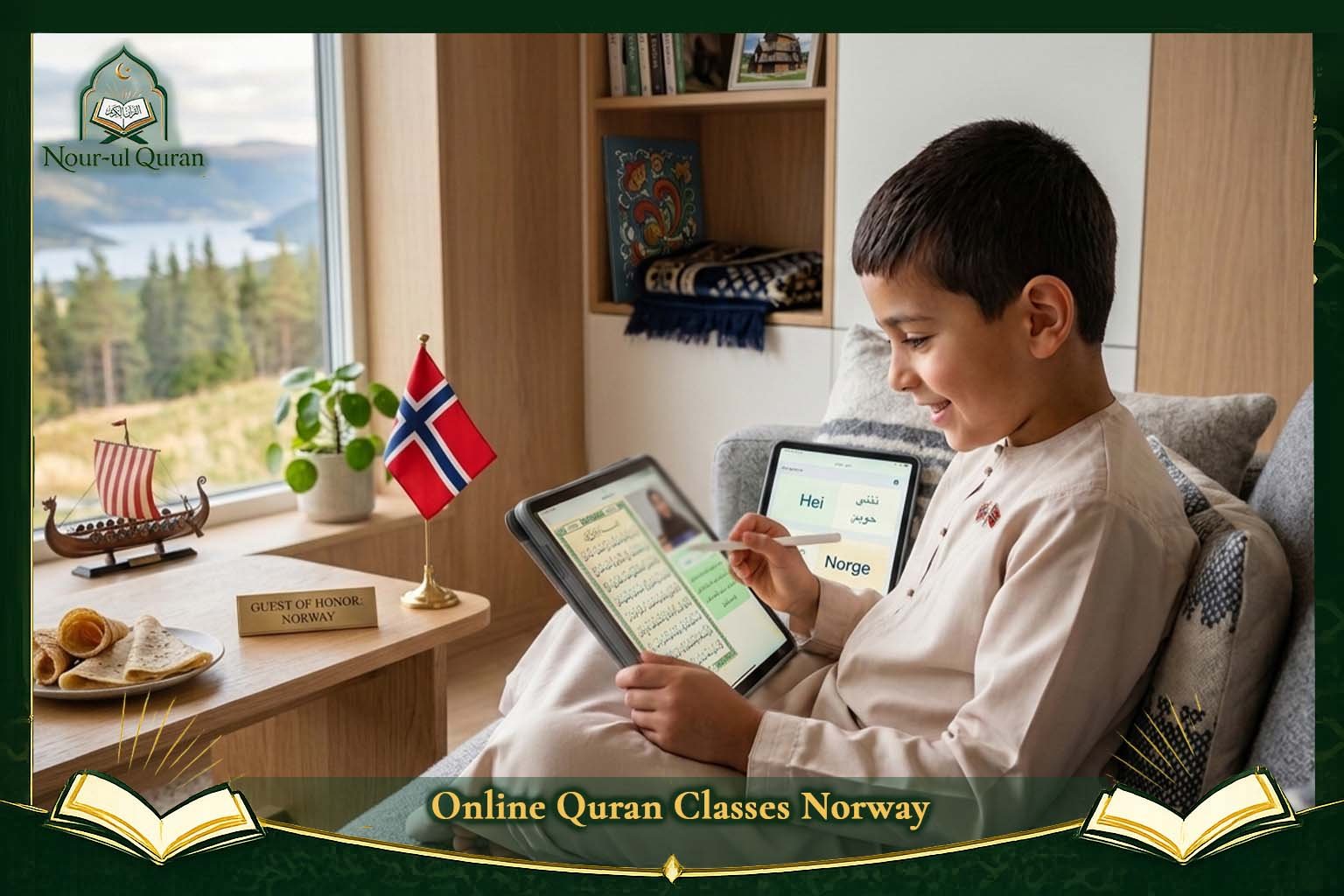
Norway's Muslim community has grown steadily over the past few decades, with the largest concentration in and around Oslo, and smaller communities spread across cities like Bergen, Trondheim, and Stavanger. Even so, plenty of families find that structured, genuinely good children's Quran education is harder to come by than they expected, especially once you move outside the capital region.
This is exactly why online Quran classes Norway wide have become such a practical option for a growing number of families. Rather than depending entirely on whatever exists within driving distance, families anywhere in the country can now reach properly trained, experienced Quran teachers, regardless of which fylke they call home.
This guide covers why this approach works well for Norwegian families specifically, how scheduling and the time difference actually play out, what genuinely matters when choosing a program, and how to get started with confidence.
Why Local Options Vary So Much Across Norway?
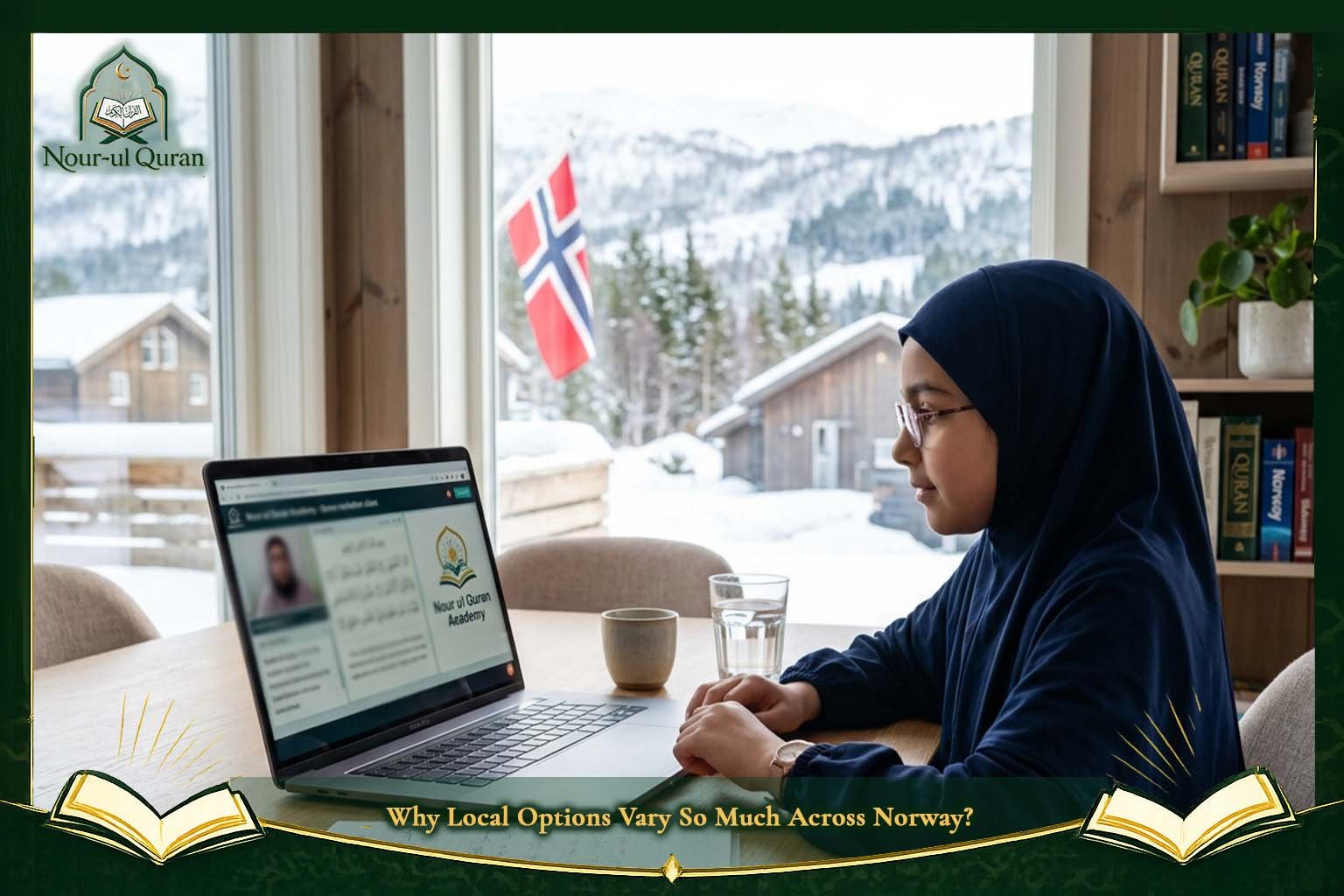
Norway's population is spread thinly across a genuinely large landmass, and its Muslim community reflects that same pattern. Oslo has the strongest concentration of mosques and community organizations, some of which run reasonably well established children's programs. Outside Oslo, options thin out fast. A family in a smaller city, or somewhere further north, might find themselves with very limited local access, sometimes nothing beyond an informal arrangement with someone in the community willing to help out casually.
Even within Oslo, demand for genuinely structured, individually paced Quran education often outpaces what local volunteer run programs can realistically offer. A lot of these programs do good, sincere work, but with one teacher frequently managing a large group of children across different ages and levels, real individual correction and pacing gets diluted.
There's also a practical seasonal factor worth mentioning. Norway's long, dark winters mean that getting a young child out the door to an evening class, week after week through several months of the year, is a genuinely bigger ask than it sounds on paper. Cold, early darkness, and often difficult driving conditions in less urban parts of the country all add friction to what should be a simple weekly routine. None of this is a reason to give up on structured Quran education. It's simply part of why more families are choosing to remove the commute from the equation entirely, since a lesson that happens wherever the family already is removes the biggest seasonal obstacle without asking anyone to compromise on quality or consistency.
The Norwegian School Day Actually Works in Your Favor
Here's something worth knowing upfront, since it changes how realistic this whole idea feels for a lot of families. Norwegian school days tend to finish notably early compared to a lot of other countries, often around two in the afternoon, with many schools finishing even earlier on Wednesdays. According to information published by Utdanningsdirektoratet, the Norwegian Directorate for Education and Training, most schools also offer SFO, a supervised after school program, giving families flexibility around exactly when their day actually wraps up.
In practice, this early finish leaves a genuinely useful window in the afternoon that a lot of other countries' longer school days simply don't offer. A Quran lesson scheduled for mid to late afternoon, well before dinner and evening routines take over, tends to land at a point when a child still has some focus left rather than being worn out from a long day, which in turn tends to make the whole routine easier to sustain over months rather than something that gets quietly abandoned once the novelty wears off.
How the Time Difference With Egypt Works?
Norway sits roughly one to two hours ahead of Egypt depending on the time of year, a small enough gap that it rarely causes real scheduling difficulty. Most established academies, including programs built specifically for international students, run teaching hours across a wide window to accommodate families across Europe.
In real terms, this means a Norwegian family can usually find a comfortable slot sometime between early afternoon and evening. It's still worth confirming directly with any academy exactly how many time slots they offer across the day, and how easily a schedule can shift if your family's routine changes, particularly around Norway's distinct pattern of holiday breaks spread through the school year.
What to Look for When Choosing a Program?
A few specific things deserve particular attention for families based in Norway.
Tutors With Real Experience Teaching Students Abroad
There's a meaningful difference between a teacher who has only worked with students physically present in an Arabic speaking classroom, and one who regularly teaches children growing up in Norway, Sweden, or similar countries, and understands the limited daily Arabic exposure that comes with a Norwegian speaking school and social life. This experience shapes how effectively a tutor actually connects with a young Norwegian student.
A Curriculum That's Genuinely Structured
Ask directly what your child will actually cover over the coming months. A serious program can describe this clearly, stage by stage. A vague answer usually signals improvised lessons rather than real structure. Our guide on how to choose an online Quran academy walks through the exact questions worth asking before committing to anything.
Flexibility Around Norway's Holiday Pattern
Norway's school year includes several shorter breaks spread throughout the year, autumn, Christmas, winter, and Easter holidays, in addition to a long summer break. A program with easy, low friction rescheduling saves a lot of frustration compared with a rigid booking system that assumes a different country's calendar.
An Honest Comparison With Local Options
If you already have some access to a mosque or community based class, it's worth weighing that against an online option rather than assuming one is automatically better. Our piece comparing online Quran academy vs local mosque lays out this tradeoff honestly.
What a Comprehensive Program Typically Includes?
A well rounded program usually spans several connected areas, often coordinated by the same tutor so a child's learning feels joined up rather than scattered.
For children starting completely from scratch, online Quran classes for beginners builds letter recognition and reading skills from the ground up, patiently and without assuming prior knowledge. For kids who already read somewhat but have never received formal pronunciation correction, online Tajweed classes focus specifically on identifying and fixing those habits.
Families pursuing memorization can follow the traditional, structured approach covered in our guide to online Quran memorization classes, which explains realistic timelines and the review method used in proper Hifz programs.
Since many children growing up in Norway have genuinely limited daily Arabic exposure, a lot of families also add online Arabic classes for kids, which makes both reading and memorization considerably more meaningful. And for the broader picture beyond reading and reciting, Islamic Studies for kids covers belief, worship, and character, while Islamic Studies for adults is worth considering for parents wanting to build their own foundation alongside their children.
Many families choose to combine two or three of these subjects together rather than treating each as an entirely separate commitment. Since the subjects naturally reinforce each other, a child memorizing a verse in one session and learning the meaning of related vocabulary in another tends to retain both far better than if the two were taught in isolation by unrelated programs. It also considerably simplifies scheduling, since coordinating one consistent team of tutors is a lot more manageable for a busy household than juggling separate providers, separate platforms, and separate weekly time slots for each individual subject.
What the First Few Weeks Typically Look Like?
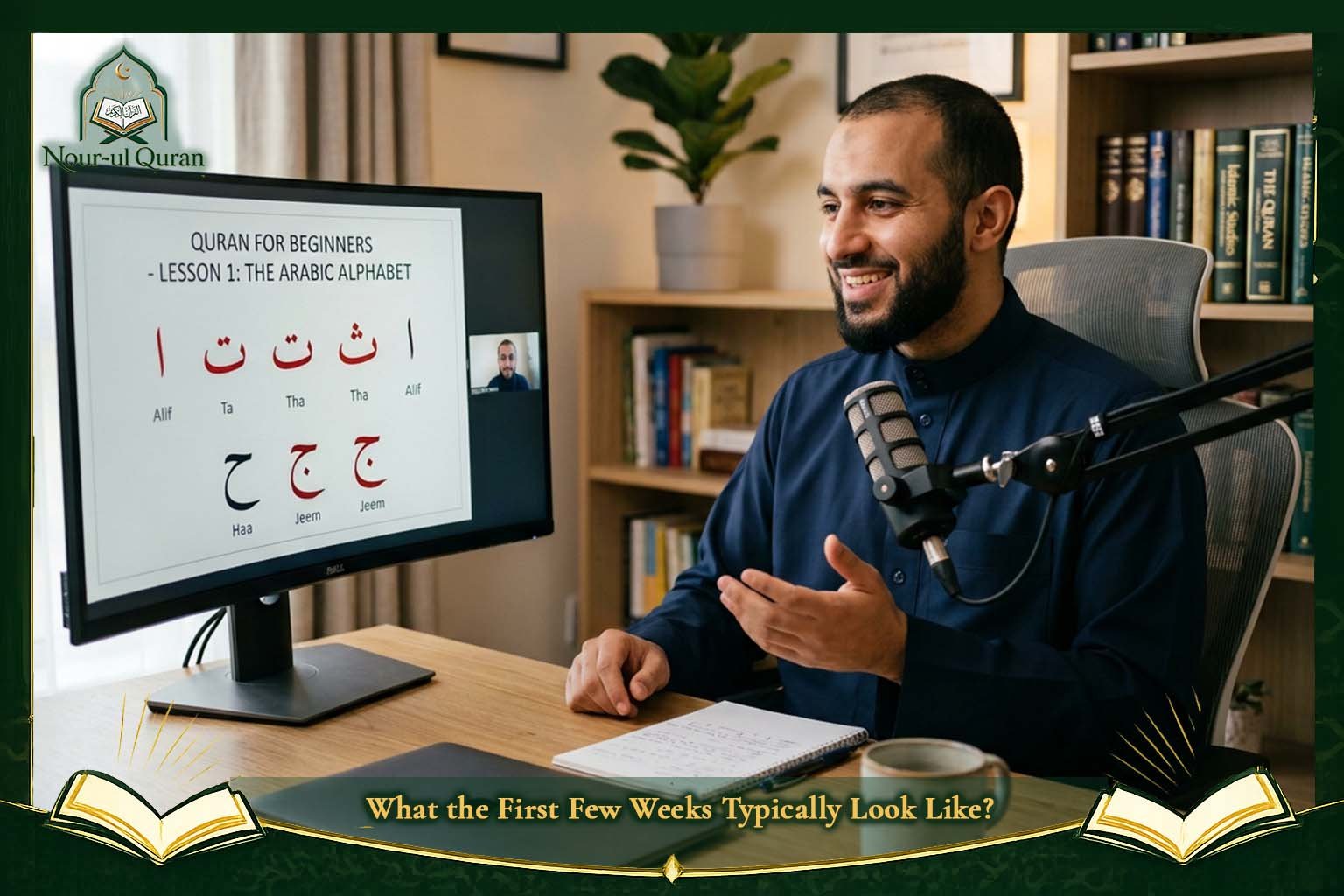
Starting something new naturally comes with some uncertainty, so it helps to know what to expect. The first session or two usually focuses on assessment rather than diving straight into new material. A good tutor asks your child to read a short passage if they have prior exposure, or begins with the very first letters if they don't, to understand exactly where they're starting from.
From there, sessions typically settle into a steady weekly rhythm. A short review of the previous lesson, new material introduced in small, manageable pieces, guided practice with real time correction, and a light, encouraging close. For younger children specifically, good tutors build in short breaks or lighter interactive moments throughout, since attention spans at that age genuinely have limits.
Homework in the early weeks is usually light, often just five to ten minutes of daily review. By around the four to six week mark, most parents notice small, concrete signs of progress, a child recognizing a letter somewhere unexpected, or repeating a phrase from their lesson without being asked. These small, unprompted moments tend to be a better sign of real progress than any formal check in, and they're usually the first indication that the routine is genuinely settling into place rather than feeling like an obligation.
It's also worth expecting some natural unevenness in the early stages. A child might grasp a particular letter quickly and then seem to struggle with the next one for longer than expected. This is completely normal, and a patient tutor accounts for it by adjusting pace rather than pushing forward regardless of how a specific lesson is landing that week.
Making It Fit a Busy Norwegian Family Life
Between school, sport, and everything else filling a typical Norwegian week, adding one more commitment can feel like a lot. In practice, shorter, more frequent sessions, two or three times a week rather than one long weekly block, tend to fit more naturally into an already full schedule, and this exact challenge is addressed directly in our guide to online Quran learning for busy families.
If you're still weighing whether structured classes are worth it compared to continuing informally at home, our overview of the benefits of joining an online Quran academy and our roundup of best online Quran learning methods both cover what real structure genuinely adds over time.
How Progress Should Actually Be Tracked?
Something worth asking any academy directly, and one of the clearest markers separating a genuinely well run program from one that just fills a weekly slot, is how progress actually gets communicated back to you as a parent. You shouldn't have to guess whether your child is improving or simply repeating similar content week after week without real movement forward.
A good program sends some form of regular update, ideally weekly, outlining what was covered, how well the material is being retained, and where extra practice at home would help. This keeps you genuinely informed without requiring you to sit in on every session yourself.
For families pursuing memorization specifically, this kind of tracking matters even more, since Hifz depends heavily on consistent review of previously memorized material, not just steady new memorization. You want clear visibility into what's been covered, what's being reviewed regularly, and where any weak spots exist that need reinforcement before they turn into bigger gaps later.
If a program can't clearly explain how they track and communicate this, treat that as a meaningful gap rather than a minor detail. Consistent, transparent reporting is usually a strong sign that a program is being run with real structure, rather than loosely improvised from one session to the next, and it's the kind of detail that tends to matter more the longer a family stays enrolled.
Adult Learners in Norway Shouldn't Be an Afterthought
While most of this guide focuses on children, it's worth mentioning that plenty of adults across Norway pursue the same kind of structured learning for themselves, whether they're reverts building a foundation from scratch, parents wanting to refresh their own knowledge before teaching their kids, or simply adults who never had the chance to learn properly growing up.
The same underlying advantages apply here. A one on one tutor, flexible scheduling that fits around work rather than the other way around, and the ability to ask questions privately without the self consciousness that can come with a group setting. Many academies, including ours, work with adult students alongside children, sometimes even scheduling family sessions so a parent and child can build this foundation together, learning side by side rather than treating it as something only the younger generation needs. For a parent who never had this kind of structured instruction growing up themselves, working through the same material their child is learning can be a genuinely meaningful experience in its own right, not just a practical convenience.
Helping Children Build Confidence in Their Identity
Beyond the technical side of reading and reciting, there's a quieter but equally important part of this worth mentioning. A lot of Muslim children in Norway are among relatively few Muslim kids in their class, navigating a Norwegian speaking, largely secular daily environment alongside a home life and faith that follow a different rhythm.
A strong Quran and Islamic Studies foundation does more than build recitation skill. It genuinely helps a child build confidence and pride in their identity, understanding not just what they practice but why, which matters just as much as the technical learning itself. Children who understand the reasoning behind what they're learning, not just the mechanics of it, tend to carry that knowledge into adolescence with far more confidence, especially while navigating a school and social environment where their faith isn't always the majority experience around them. This kind of confidence tends to matter more over time than any single technical milestone, since it shapes how a child carries their identity long after any particular class has ended.
Common Concerns Norwegian Parents Raise
"Will my child actually stay focused during an online lesson?" This depends heavily on session length and structure. Good tutors working with young children keep sessions appropriately short, typically twenty to forty minutes depending on age, with variety built in throughout rather than one long, undifferentiated block.
"What if we need to reschedule around a school holiday or a busy sport season?" A properly run academy handles this without friction, adjusting around your family's specific calendar rather than assuming a single rigid schedule applies to everyone.
"Is this actually as effective as sitting with a teacher in person?" For correction based learning like Tajweed and reading, largely yes, since accuracy depends on hearing clearly rather than physical presence in the room. A stable video connection with decent audio lets a tutor catch and correct mistakes essentially the same way they would sitting beside your child, and many parents report being pleasantly surprised at just how little is actually lost in the online format once a routine settles in.
"How do we know a tutor is actually qualified, and not just someone who reads Quran well themselves?" Ask specifically about Al Azhar training or formal Ijazah in Tajweed and recitation, rather than accepting a vague description of general experience. A teacher's own strong recitation doesn't automatically mean they know how to effectively teach a child, particularly one growing up without daily Arabic exposure.
"What happens if my child and the tutor just aren't a good match personality wise?" This happens occasionally, and it's worth asking upfront how easy it is to request a different tutor if the fit isn't right. A program that makes this simple, without a lot of back and forth, genuinely prioritizes your child's comfort over just filling a schedule slot.
A Quick Checklist Before You Commit
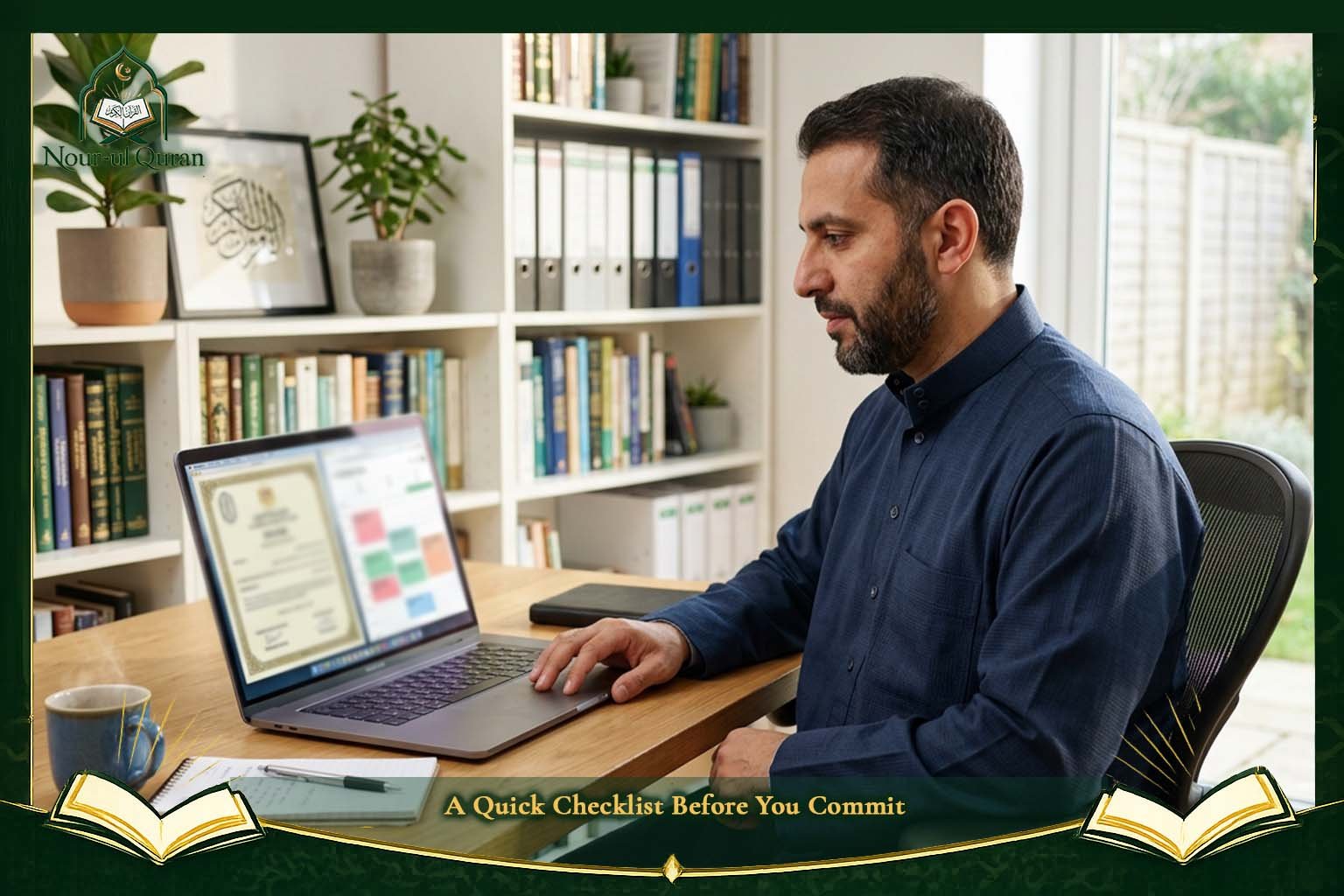
Confirm the tutor's actual qualifications directly, ideally Al Azhar trained with formal Ijazah where relevant, rather than accepting a vague description of general experience. Ask specifically whether they've taught children raised outside Arabic speaking countries before, since this context genuinely shapes teaching quality. Check how many time slots are genuinely available relative to Norwegian hours, not just a vague promise of flexibility. Confirm the rescheduling policy given Norway's spread out holiday pattern across the school year.
And take advantage of a trial class before committing to anything longer term, since watching how a specific tutor interacts with your child tells you more than any website ever could. None of these questions should feel intrusive to ask, and a program worth choosing will answer them directly and without hesitation, since transparency at this early stage is usually a fair predictor of how the actual teaching relationship will go once you commit to something ongoing.
Frequently Asked Questions
Are online Quran classes genuinely effective for children growing up in Norway? Yes. Many Norwegian Muslim children build strong reading, memorization, and Islamic Studies foundations through online classes, particularly when paired with a bit of consistent reinforcement at home.
How does scheduling work given the time difference with Egypt? The gap is small, generally one to two hours, so most Norwegian families find a comfortable afternoon or evening slot without much difficulty.
Does Norway's early school finish time actually help with scheduling? Often, yes. Since many Norwegian schools finish around two in the afternoon, there's usually a genuine window before dinner and evening routines take over, which a lot of families find works well for a Quran lesson.
What age should my child start online Quran classes? Most programs, including ours, welcome children from around age four or five, with lessons and pacing adjusted for that age group.
Can we combine Quran, Arabic, and Islamic Studies into one program? Yes, and many families find this works particularly well, since the subjects reinforce each other and simplify scheduling considerably compared to working with separate providers.
Try a Trial Class First
The clearest way to know whether online Quran classes Norway wide genuinely suit your family is to try a real session rather than deciding from a website alone. Nour-ul Quran Academy offers a trial class so you can see exactly how a lesson runs, at a time that fits your family's schedule, before committing to anything further.