
Islamic Studies for Adults: Where to Start and What to Expect
There's a particular kind of moment a lot of adult Muslims eventually reach. Maybe you grew up praying and fasting because that's what your family did, without ever really digging into the why behind it. Maybe you're a revert who came to Islam later in life and never had the chance to build a structured foundation. Maybe you've simply gotten busier over the years, and the knowledge you once had feels rusty, or full of gaps you're a little embarrassed to admit out loud.
Whatever brought you here, the good news is that Islamic Studies for adults isn't some intimidating, all or nothing commitment. It's not a choice between staying where you are or enrolling in a full seminary program. There's a real, practical middle ground, structured learning that fits around a working adult's actual life, that builds knowledge steadily rather than expecting you to absorb everything at once.
This guide walks through what a solid adult Islamic Studies program typically covers, how it differs from studying as a child, what to realistically expect time wise, and how online classes have made this kind of learning far more accessible than it used to be.
Why Adults Often Need a Different Approach Than Kids?
A lot of people assume Islamic Studies material is basically the same regardless of age, just presented with slightly more complex language for adults. In practice, good adult education looks quite different from a children's curriculum, for a few clear reasons.
Adults bring context that kids simply don't have yet. You've lived through hardship, made decisions, faced doubts, maybe even questioned things along the way. A good adult program engages with that lived experience directly, rather than relying purely on simplified stories the way children's lessons often do.
Concepts like qadar (divine decree), the wisdom behind certain rulings, or the historical context of specific verses land very differently when discussed with someone who has actual life experience to connect them to.
There's also the matter of prior exposure. Some adults grew up with strong religious education and are looking to deepen or refresh specific areas. Others are starting from close to zero, whether they're reverts or simply didn't receive much formal Islamic education growing up.
A one size fits all curriculum doesn't serve either group well, which is why a proper adult program usually starts with an honest assessment of where you're actually starting from, rather than assuming everyone begins at the same point.
Finally, adults generally want to understand the reasoning behind things, not just the rulings themselves. A children's lesson might simply explain that lying is wrong. An adult lesson digs into the nuance, exceptions scholars have discussed, the underlying wisdom, how it applies to genuinely complicated modern situations.
That depth is part of what makes adult Islamic Studies feel worthwhile rather than like a simplified repeat of what you already half remember from childhood.
Continue Your Islamic Learning at Any Age
Deepen your understanding of Islam with Islamic Studies for Adults at Nour Ul Quran Academy. Our online lessons provide adults with a convenient way to study essential Islamic knowledge while balancing work, family, and daily responsibilities.
Learn from qualified teachers through structured lessons covering important aspects of Islamic teachings and practice. Whether you are returning to Islamic learning or seeking to expand your knowledge, our flexible online classes can support your goals. Join Nour Ul Quran Academy today and take a meaningful step toward lifelong Islamic learning.

What a Solid Adult Islamic Studies Curriculum Covers?
Programs vary, but a well rounded adult curriculum typically touches several core areas, often at a deeper level than what's taught to children.
Aqeedah, the foundations of belief, explored in real depth. This goes beyond the basics into the actual theological reasoning behind core beliefs, common questions and doubts that arise around them, and how classical scholars have addressed these topics historically.
Fiqh, practical rulings, with real nuance. Adult fiqh study usually covers not just what to do, but the reasoning behind rulings, the range of scholarly opinion where it exists, and how to apply general principles to specific, sometimes messy modern situations, things like financial dealings, workplace scenarios, family matters, that a children's curriculum wouldn't typically touch.
Seerah, studied for lessons in leadership and character, not just storytelling. Adults often engage with the life of the Prophet Muhammad, peace be upon him, on a different level, looking at his approach to conflict resolution, patience under hardship, leadership decisions, and how those examples apply to challenges adults actually face.
Quranic tafsir, or deeper explanation of specific verses. Many adult programs include structured tafsir study, going beyond simply reading translation to actually understanding historical context, linguistic nuance, and scholarly commentary on specific passages.
Islamic history and the development of the scholarly tradition. Understanding how Islamic scholarship developed over centuries, the major schools of thought, and how classical scholars approached different eras' challenges gives adult learners a much richer sense of the tradition they're part of.
Practical spirituality and self development. A lot of adult programs also weave in topics like strengthening one's relationship with God, dealing with doubt, building consistency in worship, and applying Islamic principles to modern stress, work life balance, and relationships.
A genuinely good program doesn't try to cram all of this into a few sessions. It builds a path, letting you go deeper into the areas most relevant to you while still covering the broader foundation over time.
Common Reasons Adults Seek Out Islamic Studies
It helps to know you're not alone in whatever brought you here, since the reasons adults pursue this kind of learning are pretty varied.
Reverts building a foundation from scratch. For someone who came to Islam as an adult, structured Islamic Studies fills in the foundational knowledge that born Muslims often absorbed gradually throughout childhood. This is honestly one of the most common and important reasons adults seek out formal classes.
Parents wanting to answer their children's questions properly. A lot of parents realize, once their own kids start asking harder questions, that their own knowledge has gaps they'd like to fill before trying to explain things to their children.
People going through a personal reconnection with faith. Sometimes life circumstances, a hardship, a loss, a major life change, push someone to want to understand their faith more deeply than they previously had the time or inclination to.
Simply wanting to deepen an already solid foundation. Plenty of adults with a strong religious upbringing still seek out structured study specifically to go beyond what they already know, into tafsir, deeper fiqh, or Islamic history they never formally studied.
Preparing to teach or guide others. Some adults pursue Islamic Studies specifically because they want to be equipped to teach their own children, lead a small study circle, or simply be a more knowledgeable resource within their own family and community.
Whatever the specific reason, none of these paths require starting from a place of embarrassment about what you don't yet know. A good teacher meets you exactly where you are.
How Online Islamic Studies Classes Work for Adults?
Online learning has made this kind of education dramatically more accessible for adults specifically, mostly because it solves the two biggest obstacles working adults actually face: time and access to genuinely qualified teachers.
Flexible Scheduling That Fits Real Life
Unlike a fixed weekly class at a local mosque, online programs typically run across multiple time zones, seven days a week, which means you can find a slot that actually fits around work, family responsibilities, and everything else rather than rearranging your life around a single fixed session.
Access to Properly Qualified Teachers
If you live somewhere without easy access to scholars trained in classical Islamic sciences, online classes remove that barrier entirely. Learning from an Al Azhar trained instructor, for instance, is no longer limited to people who happen to live near a strong local Islamic institution.
One on One or Small Group Options
Depending on the program, adult Islamic Studies classes can be structured one on one, which allows lessons to be tailored specifically to your background, questions, and pace, or in small groups, which some adults actually prefer for the discussion element, hearing other people's questions and perspectives.
A Judgment Free Space to Ask Basic Questions
A lot of adults hesitate to ask what they worry are "basic" questions in a group setting, especially around people they know socially. A private, one on one online class removes that social pressure entirely, making it much easier to actually ask what you want to know without any self consciousness about it.
What to Expect in the First Few Sessions?
Starting adult Islamic Studies classes usually begins with an honest conversation about where you currently stand and what you're hoping to get out of it. A good teacher won't assume anything, whether that means assuming you know very little or assuming you already have a strong foundation. They'll ask, listen, and build a plan around your actual starting point and goals.
From there, most programs settle into a steady weekly or biweekly rhythm, depending on your schedule. Sessions typically combine some direct teaching with discussion, since adult learning tends to work best when it's not purely one directional. You'll likely be encouraged to ask questions throughout, including the harder ones you might not have felt comfortable raising elsewhere.
Homework, if assigned, usually involves some reading or reflection between sessions rather than memorization drills, though this varies depending on whether your focus includes Quran memorization alongside Islamic Studies specifically.
Progress in adult learning looks different from a child's progress too. Rather than visible milestones like finishing memorizing a chapter, progress often shows up as a growing ability to explain concepts clearly, connect ideas across different topics, and approach questions or doubts with more confidence and depth than before.
Questions to Ask Before Choosing a Program
What is the teacher's actual background and qualifications? Ask specifically about formal training, whether that's Al Azhar, a recognized Islamic institute, or scholarly Ijazah in relevant fields, rather than accepting vague claims of general knowledge.
How is the curriculum tailored to adult learners specifically? A program that simply repackages children's material with bigger words isn't the same as one genuinely designed for adult learning, with room for discussion, nuance, and real world application.
Is there flexibility to focus on areas most relevant to me? Some adults want to focus heavily on fiqh questions relevant to their work life, others want deeper tafsir study, others want a broad general foundation. A good program should be able to adjust based on what you actually want to get out of it.
What's the format, one on one or group? Both have value, but they suit different people. If you're someone who prefers to ask questions privately without an audience, one on one is probably the better fit.
Is a trial session available? As with any subject, trying a session firsthand before committing to a longer plan is the clearest way to know if the teaching style actually works for you.
Common Challenges Adults Face and How to Handle Them
Feeling behind or embarrassed about knowledge gaps. This is genuinely one of the most common feelings adults describe before starting. It's worth remembering that a good teacher has worked with plenty of adults starting from exactly where you are, and there's nothing unusual about needing to build or rebuild a foundation later in life.
Finding consistent time in a busy schedule. Adult life doesn't leave a lot of open space. The solution here usually isn't finding more time, it's choosing a program flexible enough to fit into the time you already have, even if that means shorter, more frequent sessions rather than long ones.
Balancing depth with practicality. It's easy to get pulled into fascinating but less immediately practical areas of study. A good program helps balance genuine intellectual depth with knowledge you can actually apply day to day.
Doubts or difficult questions surfacing during study. Deeper study sometimes brings up harder questions rather than fewer. This is normal and, honestly, often a sign of genuine engagement rather than a problem. A good teacher welcomes these questions rather than treating them as something to avoid.
Practical Ways to Get the Most Out of Adult Islamic Studies
Set a realistic, sustainable pace rather than an ambitious one you'll likely abandon after a few weeks. Consistency over months and years matters far more than intensity for a short burst.
Keep a simple journal or notes from each session. Adult learning benefits enormously from being able to look back at what you've covered, especially as topics start connecting to each other over time.
Apply what you're learning practically as you go, rather than treating it as purely academic. If a lesson covers patience during hardship, actively notice moments in your own week where that applies.
Don't hesitate to revisit basic topics even after moving on to more advanced material. Adult learners sometimes feel like going back to "beginner" material is a step backward, but reinforcing fundamentals actually strengthens everything built on top of them.
Why Adults Choose Nour-ul Quran Academy for Islamic Studies?
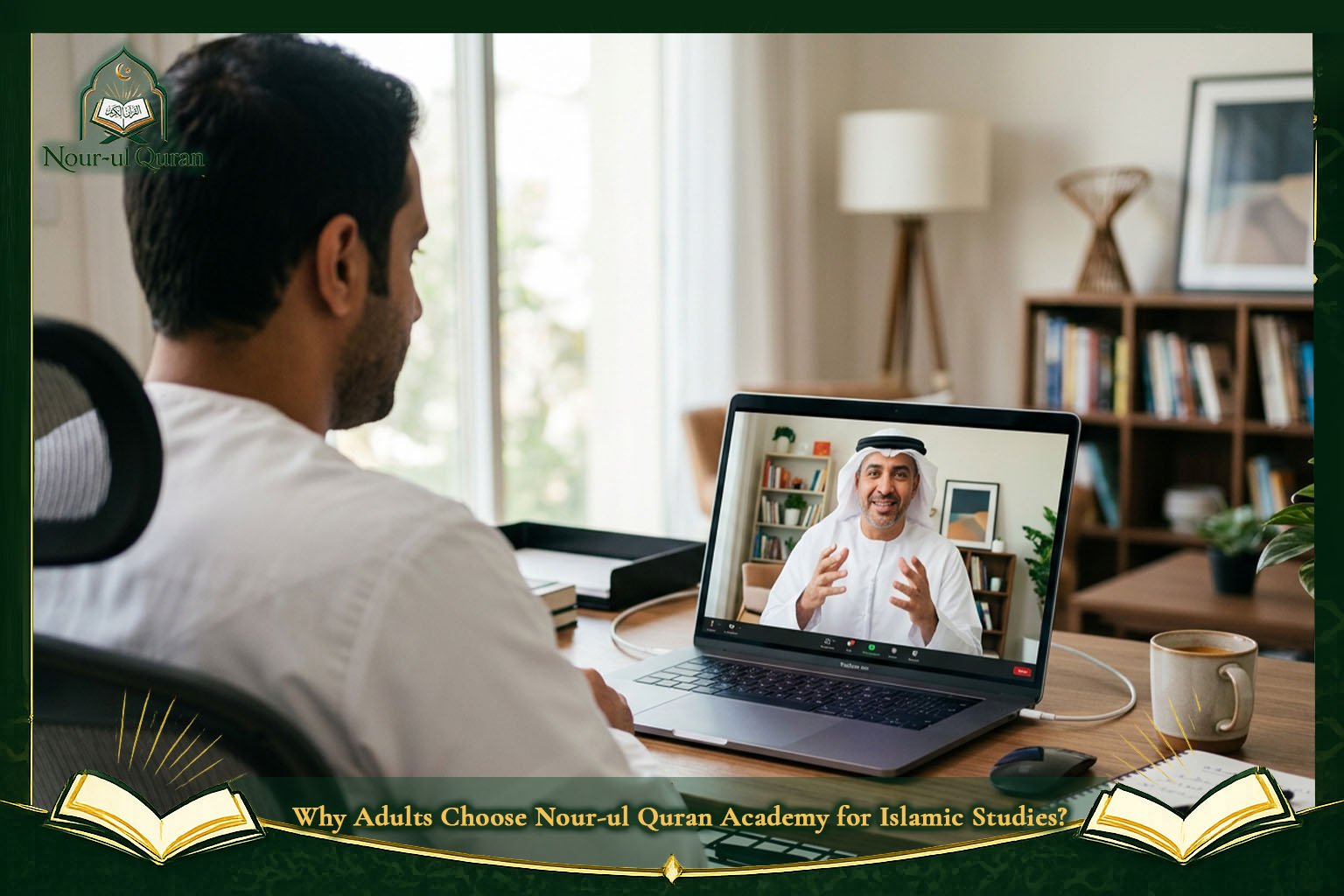
At Nour-ul Quran Academy, our Islamic Studies program isn't limited to children. We work with adult students regularly, including reverts building a foundation from the ground up, parents wanting to deepen their own knowledge, and anyone simply looking to reconnect with their faith on a more structured, meaningful level.
Our teachers are Al Azhar trained and experienced working with adult students specifically, meaning lessons are built around real discussion and nuance rather than a simplified, one size fits all script. Classes are conducted live over Zoom, one on one, so you get a program tailored to exactly where you're starting from and what you actually want to focus on.
We run classes seven days a week across all time zones, so fitting Islamic Studies into a genuinely busy adult schedule is realistic rather than one more obligation you can't keep up with. And if you'd like to combine Islamic Studies with Quran reading, Tajweed, or Arabic language learning, our team can build a program that covers all of it together rather than juggling separate, disconnected classes.
Frequently Asked Questions
Is it too late to start Islamic Studies as an adult? Not at all. Plenty of adults, including those well into their thirties, forties, and beyond, build strong, genuine knowledge later in life. There's no meaningful cutoff age for this kind of learning.
Do I need to already know Arabic to study Islamic Studies as an adult? No. While Arabic knowledge deepens certain aspects of study, particularly tafsir and Quranic exploration, a solid Islamic Studies foundation can absolutely be built without prior Arabic knowledge, with Arabic learning added alongside if you choose.
How is adult Islamic Studies different from what I learned as a child? Adult study typically goes deeper into reasoning, historical context, and nuance, and allows for genuine discussion and questions in a way that children's education, which relies more on simplified stories and basic concepts, generally doesn't.
How much time per week is realistic for adult learners? Even one focused session a week, thirty to sixty minutes, produces real progress over time if kept consistent. It's better to commit to something sustainable than an ambitious schedule you're likely to abandon after a month.
Can I focus specifically on one area, like fiqh or tafsir, rather than a broad general curriculum? Yes. Many adult students choose to focus deeply on a specific area most relevant to them, and a good program should be flexible enough to build around that preference.
Final Thoughts
Islamic Studies for adults isn't about starting over or admitting you've fallen behind. It's simply recognizing that faith, like anything worth understanding well, deserves structured attention rather than picking up fragments here and there over the years. Whether you're building a foundation for the first time or deepening knowledge you've had for decades, structured learning with a properly qualified teacher makes a real difference.
The key is finding a program that treats you as an adult learner genuinely, with room for real questions, nuance, and a pace that fits your actual life, rather than a simplified version of a children's curriculum. Try a trial session, ask real questions about the teacher's background and how the program is tailored for adults, and give yourself permission to start exactly where you are.
If you'd like to experience this firsthand, Nour-ul Quran Academy offers a trial class so you can see whether the teaching style and approach genuinely work for you before committing to anything further.