
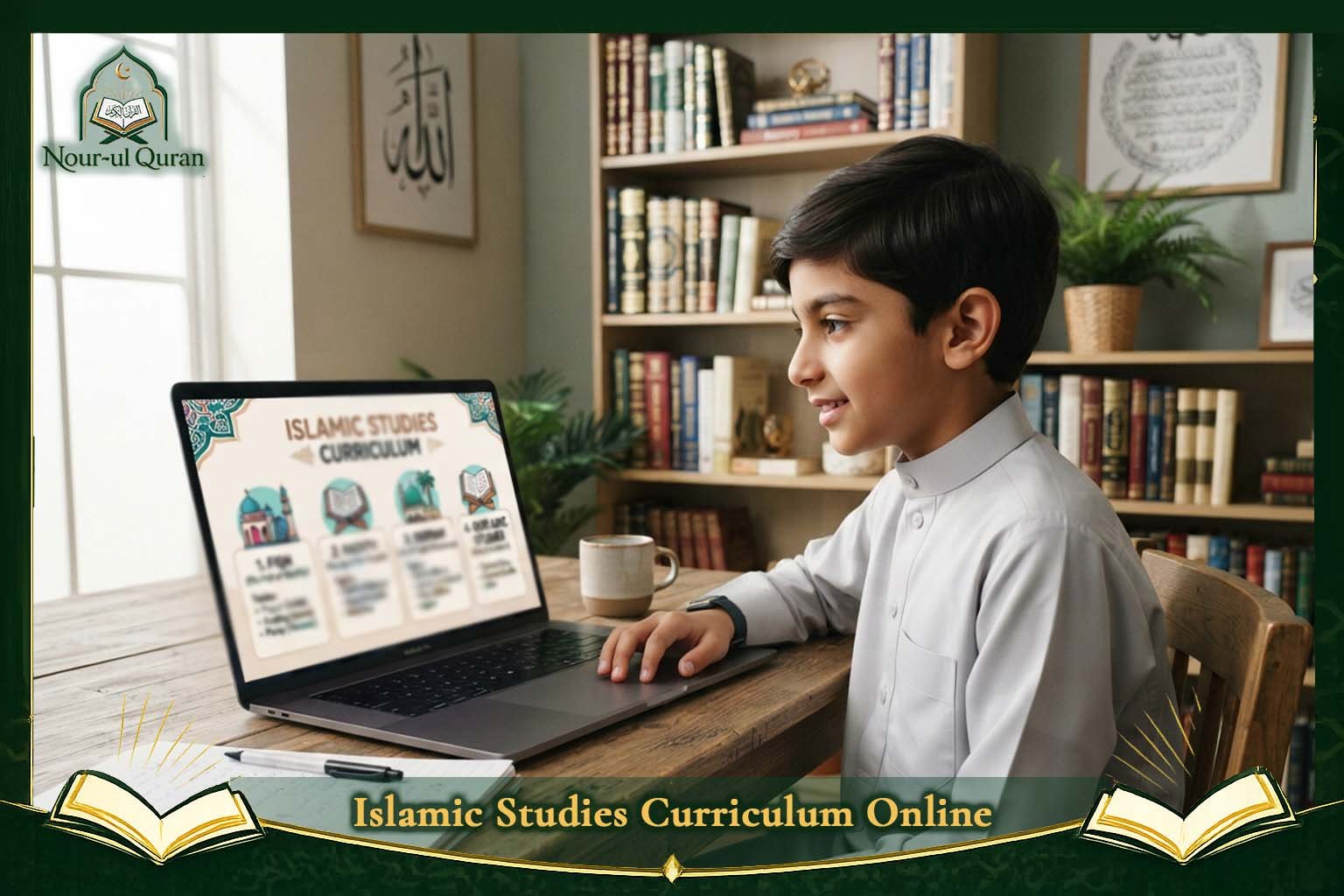
Islamic studies curriculum online options have expanded considerably in recent years, but not all of them offer real depth. Many families want more than Quran recitation alone. They want a structured grounding in belief, worship, character, and history.
At Nour ul Quran Academy, this exact need shapes how our curriculum is organized. This article walks through what the curriculum actually covers. It explains how content adapts for different ages. By the end, you will understand exactly what to expect from enrollment.
Why Islamic Studies Matters Alongside Quran Learning?
Reciting the Quran beautifully is a meaningful accomplishment on its own. Understanding the broader framework of Islamic belief adds real depth and context to that recitation. Many students, especially children raised outside a strong local Islamic community, benefit enormously from this structured exposure.
Core beliefs get introduced in an age-appropriate way throughout the curriculum. This gives students a clear framework for understanding why Muslims believe and practice what they do.
Begin Your Islamic Studies Journey Online
Looking for a structured Islamic Studies Curriculum Online for yourself or your children? Nour ul Quran Academy offers engaging lessons that help students learn essential Islamic knowledge in a clear and organized way. Join our online classes and make Islamic learning a meaningful part of your daily life.
Core Topics in Our Islamic Studies Curriculum Online
The full curriculum spans several major areas, each building on the others over time. Aqeedah covers core beliefs about God, the prophets, angels, and the afterlife.
Fiqh covers the practical how-to of worship, including prayer and fasting. Seerah walks through the life of the Prophet Muhammad, peace be upon him. Akhlaq focuses specifically on manners, honesty, and kindness in everyday situations.
- Aqeedah: foundational beliefs about God, prophets, and the afterlife
- Fiqh: practical guidance on prayer, fasting, and daily worship
- Seerah: the life and example of the Prophet Muhammad
- Akhlaq: character, manners, and everyday ethical conduct
How the Curriculum Adapts for Different Ages?
-
Curriculum for Children: Lessons for children rely heavily on storytelling and simple, clear language. Concepts get introduced gradually and repeated across different lessons for reinforcement. Interactive discussion keeps young students engaged throughout each session as well.
-
Curriculum for Adults: Adult lessons move at a noticeably faster pace than children's classes. They include more historical and scholarly context throughout each topic. Space for open discussion lets adults connect lessons to their own life experience directly.
How We Structure Weekly Lessons?
Tutors follow a deliberate sequence rather than covering topics in random order. This sequence builds understanding progressively, since each lesson revisits earlier concepts as related material appears. Consistency across weeks matters more than cramming the maximum possible content into one session.
Therefore, a slower, more thorough pace generally produces stronger long-term retention than rushing through material quickly. Additionally, this consistent structure helps parents know exactly what a student covered each week, without needing to guess or ask repeatedly.
Who Should Consider Enrolling in Islamic Studies?
This curriculum benefits nearly anyone seeking a more complete religious education overall. It proves especially valuable for children growing up outside a strong local Islamic community.
Adult reverts building foundational knowledge from scratch also benefit enormously from this structure. Families wanting a shared learning experience they can discuss together at home find real value here too.
How Historical Topics Get Brought to Life?
Seerah and broader history can feel distant if taught as a dry list of dates. Tutors are trained to bring these lessons to life through storytelling and discussion instead.
For children, historical events become engaging stories with relatable emotional stakes. Older students get invited to analyze historical decisions more critically and draw modern lessons from them.
- Storytelling techniques used specifically for younger students
- Analytical, discussion-based approaches for older students and adults
- Connecting historical events to challenges students face today
- Regular review woven throughout to reinforce long-term retention
How Assessment and Progress Tracking Work?
Unlike Quran memorization, where progress is easy to measure by counting verses, Islamic studies works differently. Progress tracking focuses on comprehension and application rather than pure repetition or memorization.
Tutors regularly check understanding through open discussion rather than formal, high-pressure tests. Periodic review sessions revisit earlier topics, since these concepts benefit significantly from spaced repetition over time.
How This Curriculum Was Developed?
Our team did not assemble this curriculum arbitrarily or without careful thought. Instead, it draws on established traditional teaching sequences used widely in Islamic schools. We adapt these sequences specifically for an online, one-on-one learning environment.
Furthermore, ongoing feedback from tutors actively teaching the material continues shaping small refinements over time. As a result, the curriculum evolves gradually rather than staying frozen as a fixed, unchanging document.
How This Compares to a General Weekend Islamic School?
Many families have previously attended a general weekend Islamic school program locally. Those programs often teach large groups with limited individual attention available. By contrast, our one-on-one format allows a tutor to adjust pace for one specific student.
Consequently, a student who grasps a concept quickly can move ahead without waiting for classmates. Similarly, a student needing extra time on a difficult topic receives that time without falling behind a group schedule. This individualized structure, therefore, often produces deeper understanding than a typical large weekend program can realistically offer.
How Discussion-Based Learning Builds Confidence?
Traditional religious education sometimes relies heavily on memorized recitation of facts and dates. Our curriculum instead emphasizes discussion and genuine questioning throughout each lesson. For example, a tutor might ask a student why a particular rule exists, not just what the rule says.
This approach, therefore, builds reasoning skills alongside factual knowledge. Moreover, students who learn to ask thoughtful questions in class often carry that habit into their broader religious life. Ultimately, this confidence to ask and explore matters just as much as the specific facts a student memorizes along the way.
How Islamic Studies Complements Character Development at Home?
Parents frequently report that Akhlaq lessons create natural conversation starters at home. Families gain a shared vocabulary for discussing honesty, patience, and kindness in everyday situations.
This ripple effect, where classroom lessons shape everyday family conversations, is one of the most valuable benefits families describe. It extends learning well beyond the actual lesson time itself.
Handling Difficult or Sensitive Questions
Children and adults alike sometimes raise difficult questions during Islamic studies lessons. A young student might ask why bad things happen to good people, for example. An adult might question how a specific historical event should be understood today.
Good tutors do not dismiss these questions or rush past them uncomfortably. Instead, they engage thoughtfully, drawing on scholarly sources rather than personal opinion alone.
This approach, therefore, teaches students that sincere questions deserve sincere answers, not deflection. Over time, this builds a habit of genuine inquiry rather than passive acceptance without any real understanding behind it.
Supporting Multilingual Families Through the Curriculum
Many families enrolled in our program speak a language other than English at home. Consequently, tutors remain flexible about explaining concepts using familiar terms from a family's native language when helpful.
This flexibility does not compromise the curriculum's core content in any way. Rather, it simply removes an unnecessary language barrier that could otherwise slow a student's genuine understanding.
Additionally, students often bring vocabulary from their home language into class discussions naturally. Tutors welcome this exchange, since it frequently deepens a lesson rather than distracting from it.
Why Consistency Across Terms Matters More Than Speed?
Some families ask whether the curriculum can be accelerated to cover more content quickly. While pacing does adjust for genuinely advanced students, we generally discourage rushing through material for its own sake.
Rushing tends to produce shallow familiarity rather than lasting, applicable understanding. Instead, we prioritize steady, consistent progress across each term of enrollment. This consistency, over months and years, ultimately produces far deeper knowledge than a faster but shallower pace ever could achieve.
How to Get Started With Islamic Studies?
Starting is straightforward and requires nothing more than a brief initial conversation. This conversation covers current knowledge level and specific goals for the course ahead. From the very first lesson, the tutor adjusts pacing based on how quickly a student absorbs concepts.
Consequently, no student moves through material faster than they can genuinely process and retain it. Families interested in getting started can explore our Islamic studies for kids or Islamic studies for adults programs directly through Nour ul Quran Academy today.
Frequently Asked Questions
The sections above cover curriculum content, structure, and how progress gets tracked over time. A few additional questions come up often once families consider enrolling in this specific program. These answers address points not covered in detail earlier.
Is Islamic studies taught separately from Quran classes, or combined?
Both options are available depending on family preference. Some students choose a dedicated islamic studies track, while others prefer combining it directly with their existing Quran recitation or memorization lessons each week.
What age can a child realistically start Islamic studies lessons?
Children as young as five or six can begin with simplified, story-based lessons. Depth and complexity increase naturally as children grow older and their comprehension abilities continue developing over subsequent years.
Do I need any prior religious knowledge to enroll as an adult?
No prior knowledge is required at all. Adult lessons are designed to work equally well for complete beginners and for those looking to deepen already-existing religious knowledge and understanding.
How long does it take to complete the full curriculum?
There is no fixed completion timeline, since the curriculum is designed for ongoing, ideally lifelong learning rather than a course with a hard finish line most students reach within a set number of months.
Can siblings of different ages attend Islamic studies together?
This depends on the specific age gap involved. Similarly-aged siblings often benefit from shared discussion, while a wide gap generally works better with separate, age-appropriate sessions tailored to each child specifically.
Does the curriculum follow one specific school of Islamic thought?
The curriculum presents mainstream, widely accepted positions while acknowledging that scholarly differences exist on certain finer points, encouraging respectful understanding of this diversity rather than presenting only one narrow view as absolute.
In conclusion, our islamic studies curriculum online is designed to give students a genuinely well-rounded understanding of their faith. It goes well beyond the ability to simply recite scripture correctly. Covering Aqeedah, Fiqh, Seerah, and Akhlaq together builds a complete foundation over time.
Nour ul Quran Academy structures this curriculum thoughtfully for both children and adults alike. Starting this journey now gives your family a shared language for discussing faith and character at home.

Add New Comment