
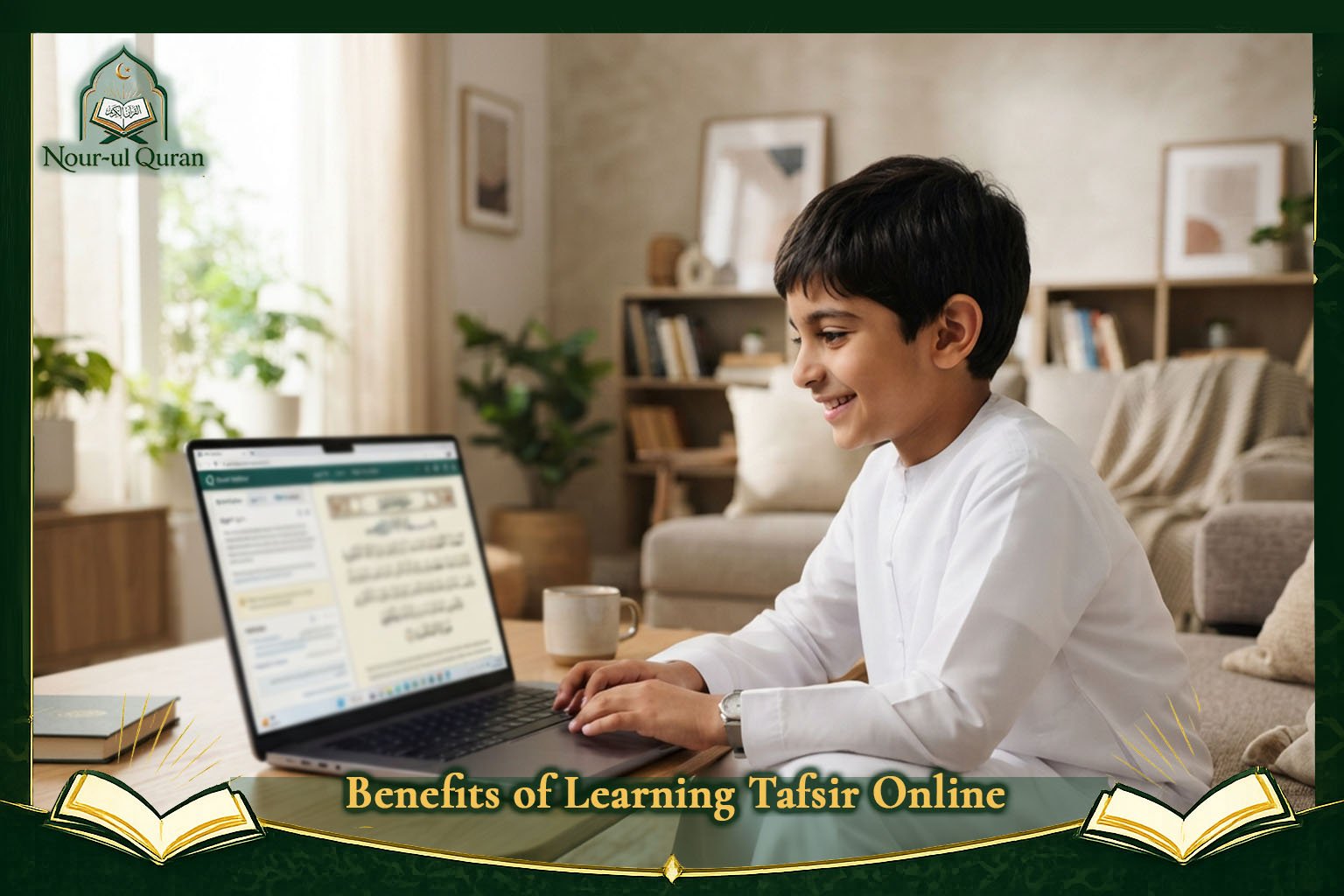
Benefits of learning tafsir online extend far beyond simply knowing more facts. Reciting verses correctly is meaningful on its own. Understanding what those verses mean adds a different layer of depth. At Nour ul Quran Academy, many students eventually reach a point where recitation alone no longer feels like enough.
This article explains what tafsir covers. It also explains why studying it online has become so accessible. Finally, it covers who benefits most from starting. By the end, you will see why this step matters for a deeper connection to scripture.
What Tafsir Actually Covers?

Tafsir goes beyond simple word-for-word translation. It draws on historical context and linguistic analysis. It also draws on centuries of scholarly explanation. A single verse can carry layers of meaning. These layers only become visible once context is explained properly.
Many verses were revealed in response to specific events. Others answered specific questions the early Muslim community faced. Understanding this background changes how a verse is applied today. Plain reading alone simply cannot provide that depth.
Understand the Quran Beyond Recitation
Learning Tafsir online gives you the opportunity to explore the meanings, lessons, and guidance contained in the verses of the Quran with the support of knowledgeable teachers.
At Nour Ul Quran Academy, our online Tafsir lessons make it easier to study from home while developing a deeper understanding of the Quran at your own pace. Enroll now and discover how learning Tafsir online can strengthen your understanding and connection with the Quran

Benefits of Learning Tafsir Online That Stand Out
Several specific benefits explain this growing shift toward online study. Flexibility ranks near the top of the list. Students can study at their own pace. They are not locked into a fixed group schedule. Access to specialized scholars matters too.
A student without a local tafsir expert can now study anywhere. Scheduling flexibility rounds out the picture nicely. Working adults can sustain consistent study around existing commitments. This kind of learning usually takes months, not weeks.
- Learning at your own pace instead of a fixed group schedule
- Direct access to specialized scholars regardless of your location
- Flexible scheduling around work, family, and other commitments
- Recorded sessions that make review and repetition much easier
- Lower overall cost compared to traveling for specialized instruction
How Tafsir Study Changes Daily Recitation?
-
Adding Emotional and Spiritual Weight: Students often report a real shift after starting tafsir. Understanding a verse's meaning changes how it feels during recitation. A verse recited with genuine understanding carries more weight. It feels different than one recited purely by sound. This emotional connection often deepens motivation for daily practice.
-
Improving Long-Term Memory Retention: Meaning also aids memorization directly and noticeably. A verse connected to understood context tends to stick better. It sticks more reliably than one memorized through repetition alone. Students studying tafsir alongside memorization often notice this quickly. Retention improves measurably within just a few months of combined study.
Common Misconceptions That Delay Getting Started
Many students delay tafsir study for years. Their reasons often do not hold up under closer look. Some believe tafsir is only for advanced scholars. This is simply inaccurate in most cases. Qualified teachers make the material accessible to any sincere learner. Others believe they should finish memorizing first. In practice, tafsir and memorization often progress well together. Understanding actively reinforces retention rather than competing for study time.
Who Benefits Most From Studying Tafsir?
Any student can benefit from tafsir study eventually. However, certain groups find it particularly transformative. Adults who already recite comfortably sometimes feel their understanding has plateaued. Tafsir often reopens verses they had recited countless times.
Suddenly, familiar verses reveal meaning they had never truly grasped. Parents also pursue tafsir study for a practical reason. They want to answer their children's questions with genuine confidence. Deferring every question elsewhere starts to feel unsatisfying over time.
What a Typical Online Tafsir Course Looks Like?
Most courses begin with shorter surahs. These are usually surahs students already recite in daily prayers. Starting here lets students notice new meaning immediately. Familiar verses suddenly reveal depth students had missed for years.
As students advance, courses often shift toward thematic study. Verses get grouped by topic instead of strict sequence. Regular discussion time is usually built into each session too. Students ask questions and connect meaning to their own daily lives.
- Starting with short, frequently recited surahs for early motivation
- Gradually introducing historical and linguistic context along the way
- Moving toward thematic study across related, connected verses
- Building in regular discussion and real-life application time
What to Look for in a Qualified Tafsir Teacher?
Not every recitation tutor is qualified to teach tafsir well. It requires specialized scholarly training beyond pronunciation expertise. A qualified teacher explains their scholarly background clearly.
They also explain which school of interpretation they draw from mainly. Good teachers structure lessons to build understanding progressively. They avoid jumping between unrelated verses without any clear plan.
How Online Format Compares to Traditional In-Person Study?
Traditional tafsir study often required years of travel or relocation. Finding a qualified local scholar was historically difficult for most students. Online platforms have removed that barrier almost entirely now. A student anywhere can connect directly with a specialized teacher.
This does not mean online study is simply a lesser substitute. Recorded sessions actually offer an advantage traditional classes rarely provide. A student can revisit a difficult explanation multiple times if needed. This repetition often deepens understanding beyond what a single live lecture allows.
How Nour ul Quran Academy Supports Tafsir Students?
Nour ul Quran Academy connects students with instructors trained specifically in tafsir. These are not simply general recitation teachers stretched thin. Lessons build steadily from familiar surahs toward broader thematic understanding.
Students are encouraged to ask questions actively throughout each session. Discussion, rather than passive listening, tends to produce the deepest understanding. This approach reflects how tafsir has traditionally been taught for centuries.
How Tafsir Deepens Understanding of Daily Prayers?
Most Muslims recite the same short surahs multiple times daily during prayer. Without tafsir, these verses can eventually feel routine or automatic. Understanding their meaning changes this experience noticeably. A student who understands Surah Al-Fatiha's meaning, for example, often describes prayer feeling more personal afterward.
The words stop being simply memorized sounds. They become an active conversation with real, understood meaning behind every line. This shift alone motivates many students to begin tafsir study, even those who initially had no interest in deeper scholarly topics.
Balancing Tafsir Study With a Busy Schedule
Many adults worry tafsir study requires more time than they can realistically spare. In practice, even thirty minutes a week produces steady progress over time. Short, consistent sessions tend to outperform occasional long study blocks anyway. A student reviewing one short passage weekly, with proper explanation, builds genuine understanding gradually. This pace fits comfortably around work, family, and other existing responsibilities. There is no need to treat tafsir as an all-or-nothing academic pursuit requiring hours of daily study.
How Tafsir Study Supports Broader Islamic Studies?
Tafsir does not exist in isolation from other areas of Islamic learning. Understanding a verse's context often connects naturally to seerah, the life of the Prophet. It also connects to broader Islamic history and early community events. Students studying tafsir alongside general Islamic studies often notice these connections reinforcing each other.
A historical event studied in seerah suddenly appears again inside a Quranic verse's revealed context. This overlap helps knowledge stick more firmly than studying each subject in complete isolation from the others.
Questions Worth Asking Before Choosing a Course
Not every online tafsir course is structured equally well. Ask how the curriculum is organized before enrolling. Ask whether sessions include time for questions and discussion.
Ask about the instructor's specific scholarly background as well. A course built around passive listening alone rarely produces the deepest understanding. One built around active discussion, guided by a qualified teacher, tends to serve most students far better over the course of their studies.
Getting Started With Structured Tafsir Study

Moving from reciting words to understanding their meaning is a real step. Starting with a structured course removes much of the initial uncertainty. Our online Quran tafsir course connects you with a qualified instructor directly. It follows a clear, progressive curriculum built for real students. It is not designed only for academic specialists.
Frequently Asked Questions
The sections above cover what tafsir involves and how a typical course unfolds. A few related questions come up often once students consider enrolling. These answers address points not covered in detail earlier.
Do I need advanced Arabic skills before starting tafsir study?
No. Many tafsir courses are taught with translation and explanation in the student's primary language. Relevant Arabic vocabulary is naturally introduced along the way as a student's understanding gradually deepens over time.
How long does it take to notice real benefits from tafsir study?
Many students notice a shift in how familiar verses feel within the first few months. Building comprehensive understanding across the entire Quran remains a longer, ongoing journey that continues for years afterward.
Can children study tafsir, or is it mainly for adults?
Older children and teenagers can benefit from age-appropriate tafsir instruction. It is often introduced gradually alongside their existing memorization and recitation studies, not as a completely separate subject.
Is tafsir study more expensive than standard recitation lessons?
Pricing varies by academy and instructor specialization. Tafsir instruction is generally comparable to other specialized subjects like advanced tajweed, reflecting the additional scholarly training required to teach it well.
What if I disagree with a particular scholarly interpretation presented in class?
Respectful discussion is normal and encouraged in most quality tafsir courses. Scholars have historically held varying interpretations on certain points, and a good teacher explains the reasoning behind each view fairly.
Can tafsir study be combined with qira'at or advanced tajweed courses?
Yes, many advanced students pursue these subjects together. Understanding meaning often reinforces precision in recitation, creating a more complete and mutually reinforcing course of study overall.
In conclusion, benefits of learning tafsir online reach well beyond simply gathering facts about scripture. They transform daily recitation into something felt more deeply. They also aid long-term memorization in a measurable way. Parents gain confident answers for their children's honest questions.
Common misconceptions, like believing tafsir is only for scholars, keep many students waiting years longer than necessary. Nour ul Quran Academy makes qualified tafsir instruction accessible from wherever you are. Starting this journey now is often the biggest step toward genuinely understanding the Quran.

Add New Comment